
Quick answer
Key takeaways
- Attribution connects marketing spend to actual ticket revenue, not just clicks or impressions.
- ROAS and CPA only mean something when calculated against real ticket revenue, not platform estimates.
- TickX IQ shows revenue, orders, and AOV by channel, source, and campaign in one unified dashboard.
- Offline channels like brand partnerships and OOH can be attributed using unique tracking links and QR codes.
The best experience marketers share one advantage over everyone else: they know exactly what's driving revenue. Not approximately. Not intuitively. They can point to a specific channel, a specific campaign, and say with confidence, this is what's working, and this is what we're putting more behind.
That level of clarity is driven by accurate attribution data. It connects your marketing activity directly to ticket revenue, giving you a single view of performance that replaces guesswork with evidence, and makes it the foundation of any effective marketing strategy.
What Is Attribution in Event Marketing?
Attribution is the process of identifying which marketing touchpoints influenced a ticket sale.
This means connecting the channels and campaigns your buyers came from, whether through organic search, paid social, email, or display, to the revenue they generated. Rather than measuring clicks or impressions in isolation, attribution ties each channel to actual revenue, so you can see not just who engaged with your marketing, but who bought a ticket because of it.
The most common approach is last-touch attribution, which assigns credit for a sale to the final interaction before purchase. It's straightforward to implement, easy to interpret, and gives operators a reliable baseline for understanding which channels are driving conversions.
Why Is Event Marketing ROI So Hard to Measure?
For most experience marketers, proving the impact of marketing spend is one of the harder parts of the job.
The biggest challenge is that every ad platform speaks its own language. Meta reports performance within Meta. Google Ads reports within Google Ads. Each platform optimises for its own metrics and attributes success by its own rules. Without a neutral source of truth that connects all of them to actual ticket revenue, it's almost impossible to make meaningful comparisons across channels or understand how your overall marketing mix is performing.
The second challenge is a reliance on proxy metrics. Clicks, impressions, and engagement rates are easy to report on, but they don't tell you whether a campaign actually sold tickets. Measuring only what's easy to measure leads to misallocated spend, with budget flowing toward the channels that look best on their own dashboards rather than the ones generating real revenue.
Which Marketing Metrics Actually Tell You What's Working?
Once proper attribution tracking is in place, the metrics that matter become clear.
Revenue by channel and campaign is the foundation. Knowing exactly how much ticket revenue each channel generated (not just how many clicks or impressions it drove) is what leads to better budget allocation.
From there, you can calculate the metrics that define campaign efficiency. Return on Ad Spend becomes straightforward once you have revenue per campaign. If a paid social campaign generated $20,000 in ticket revenue from $5,000 in spend, that's a 4x ROAS, a clear benchmark you can use to compare against other channels and inform future allocation. Cost Per Acquisition works the same way: total campaign spend divided by the number of ticket buyers it produced gives you a number you can track, compare, and improve over time.
Conversion rate by traffic source rounds out the picture. Two channels can drive the same volume of sessions to your booking page while converting at very different rates. A source that converts at 12% is twice as valuable as one converting at 6%, even if both generate the same raw traffic. Understanding that gap tells you where your audience is most engaged and most ready to buy.
How Does TickX IQ Connect Marketing to Revenue?
TickX IQ brings your marketing and ticketing data together in one place, so you're no longer comparing numbers across platforms that each tell a different story.
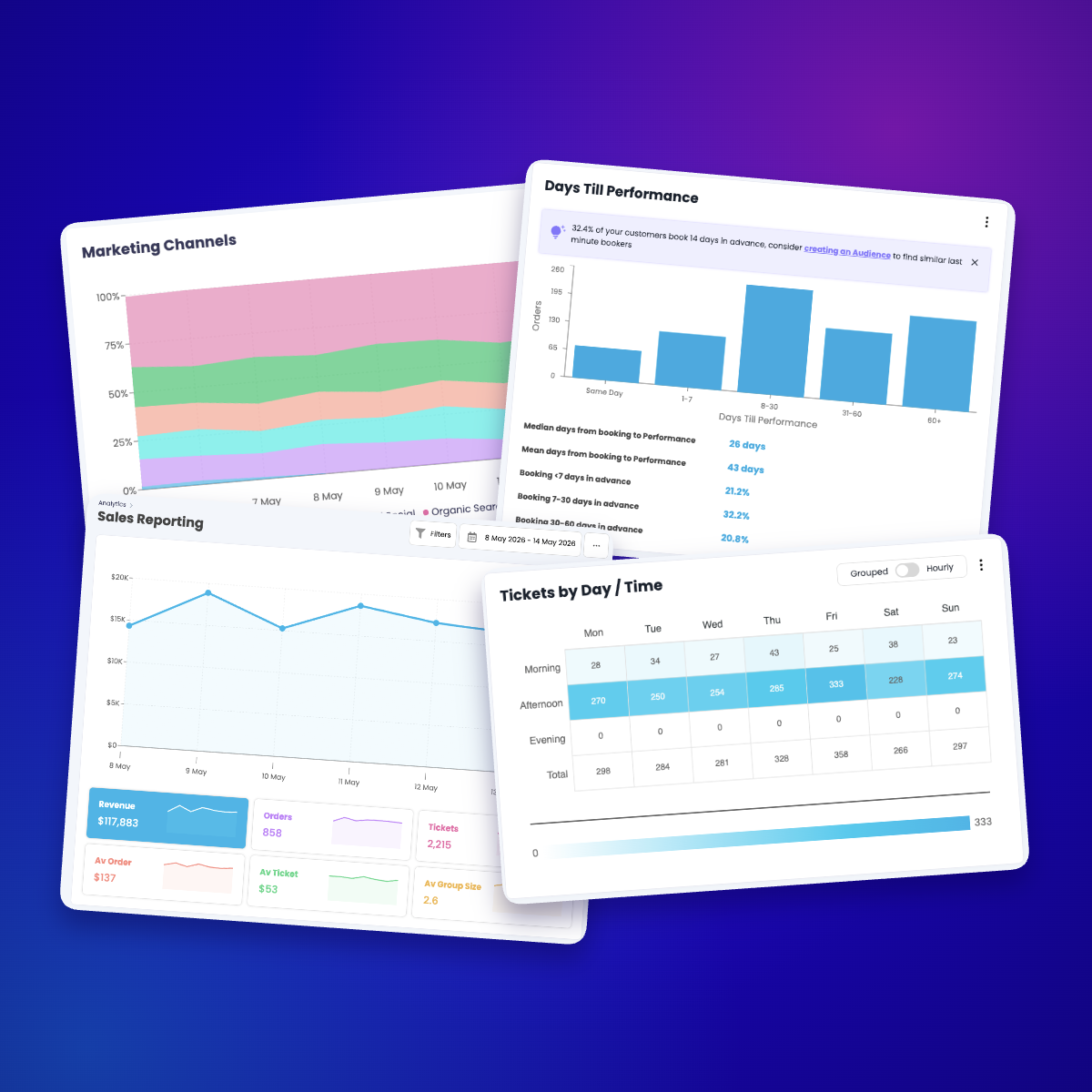
Campaign performance sits alongside real revenue data in a single dashboard built specifically for ticketing. UTM parameters are used to track exactly where each visitor came from and which campaign drove them, feeding into a breakdown of orders, tickets sold, revenue, and average order value by channel, source, and campaign. That revenue data is what makes it possible to calculate ROAS and CPA with confidence, using actual revenue as the source of truth rather than platform-reported estimates.
The traffic source dashboard takes this further, showing every channel driving sessions to your booking page alongside the conversions each one produced. Organic search, paid social, Google paid, email, display, and referral all appear in a single view, so you can see not just where your traffic is coming from, but which sources are actually turning browsers into buyers.
Beyond digital, IQ can also bring offline activity into the same picture. For brand partnerships, influencer campaigns, and out-of-home marketing, unique tracking links and QR codes can be generated. Any revenue those campaigns drive appears in the same dashboard as your digital campaigns, giving you a single, complete view of what's working across every channel.
The result is that budget decisions stop being based on which platform reports the most impressive numbers and start being based on which channels are actually generating revenue.
What Does Strong Attribution Practice Look Like?
The operators who measure marketing ROI most effectively tend to share a few habits.
They define success in revenue terms before a campaign launches. Rather than optimising for clicks or reach, they set a target for tickets sold or revenue generated per channel, and use that as the benchmark against which performance is measured.
They use the same attribution methodology consistently, so comparisons across campaigns and time periods are meaningful. Consistency is what makes trends visible and performance improvements provable.
They treat attribution as an input to the next decision, not just a record of the last one. The value of knowing that one channel outperformed another last month is in how it shapes the budget allocation this month.
The Bigger Picture
For experience operators, the opportunity that smarter marketing attribution unlocks is significant. Every channel you run is an investment. What sets the best operators apart isn't just that they measure attribution. It's that they trust it. When your performance data comes from a single, unbiased source rather than each platform reporting its own version of events, you can be confident in what it's telling you, and confident in the decisions you make because of it.
The operators who build this capability compound their advantage over time. They learn what their audience responds to, allocate more precisely with each campaign, and generate more revenue from the same marketing budget, not by spending more, but by spending smarter.

Latest Articles

How to Find the Audience Segments in Your Ticketing Data (With 3 Worked Examples)

Cart Abandonment Recovery for Ticketed Events
The 5 Metrics Every Ticketing Operator Should Track, And How to Act on Them