Quick answer
Key takeaways
- Conversion rate reveals exactly where buyers drop off, and funnel analytics make every stage testable and directly improvable.
- Revenue breakdown moves you from knowing how much you made to understanding precisely what generated it.
- Marketing channel attribution connects campaign spend to real ticket revenue in a single dashboard.
- Traffic mix shows which sources convert, not just which ones drive volume, which is essential for smart budget allocation.
- Sales timing data lets you schedule campaigns at the exact moment your audience is ready to buy.
The best-performing experience operators share a common trait: they always seem to know what to do next.
When a show or experience needs a push, they know which audience to reach and which channel to use. When an experience or performance is trending ahead of target, they know how to capture the momentum. When a campaign works, they can prove it and scale it. When it doesn't, they move on quickly and reallocate the budget.
That clarity isn't luck or instinct. It's the result of having the right numbers in front of you, at the right time, connected to the right actions.
Here are the five metrics that make that possible.
1. Conversion Rate
Conversion rate is one of the most useful numbers in any operator's toolkit. It tells you what proportion of people who start the booking process actually complete it, and more importantly, where the rest drop off.
Funnel analytics break the purchase journey into its individual stages, from browsing the calendar through to final checkout. With that level of visibility, you can see exactly which step is causing friction, rather than knowing only that overall conversion is lower than you'd like. Each stage becomes something you can test and improve, with results that show up directly in ticket revenue.
TickX customers have seen an average 12–20% improvement in conversion rates after optimising their booking flow, with some operators exceeding 25%.
2. Ticket Revenue Breakdown
Total revenue is a useful headline, but it's the breakdown underneath that tells you what's actually driving it and where the real opportunities are.
TickX IQ lets you slice revenue across multiple dimensions: by ticket type, so you can see how general admission, premium, and VIP tiers are each performing; by add-on sales, revealing which additional products are converting; by group size, showing whether your audience skews towards solo visitors, couples, or larger groups; and so much more.
That granularity changes the kinds of decisions you can make. If a particular add-on is appearing in nearly a quarter of all orders, that's worth surfacing more prominently in the booking flow. If the majority of purchases happen between 11am and 1pm, that's when your email campaigns should be hitting.
The goal is to move from knowing how much revenue you made to understanding exactly what generated it, so every future decision is grounded in something real.
3. Marketing Channel Attribution
The best experience marketers know exactly which channels are driving ticket sales, enabling them to use data to drive more strategic decision-making and improve their return on ad spend.
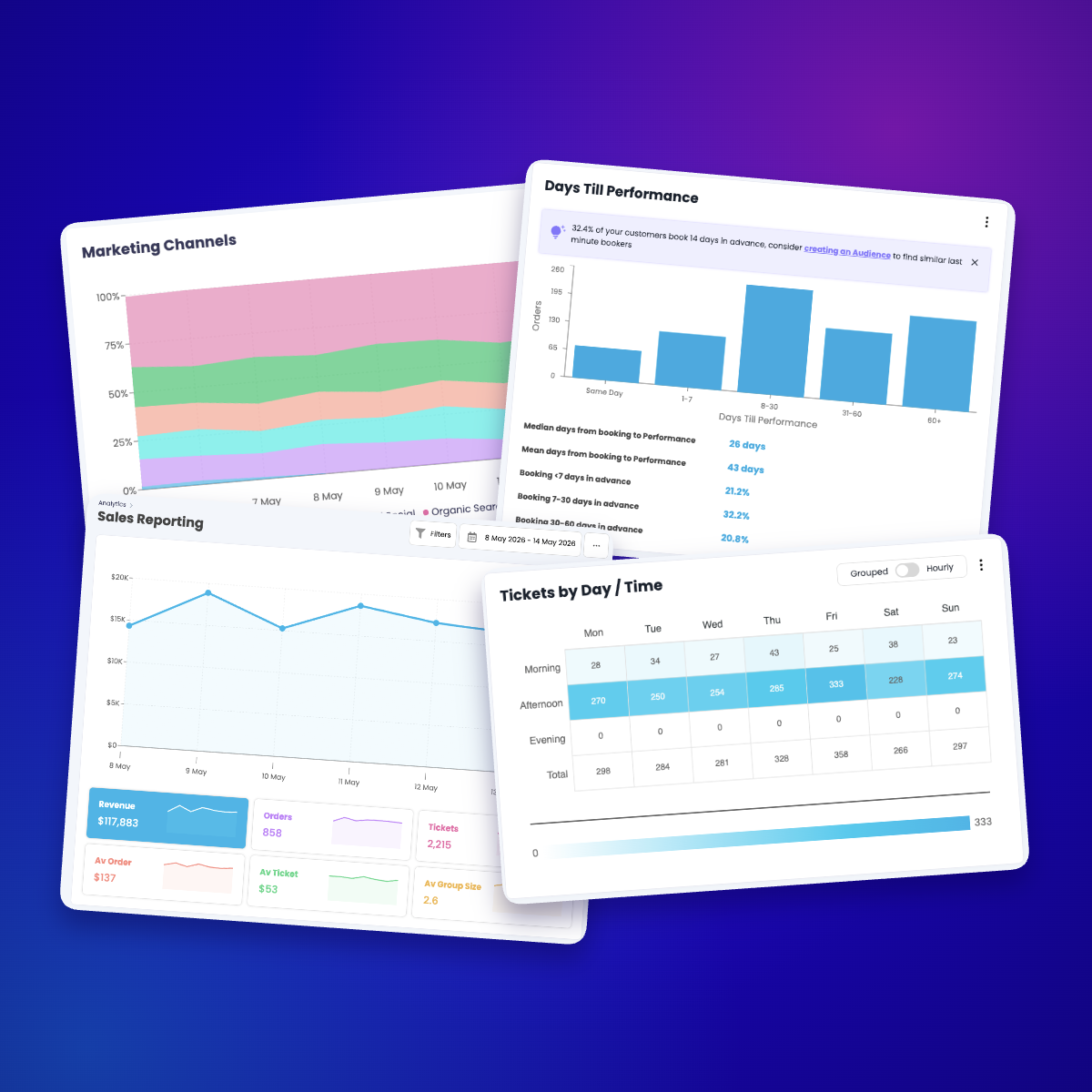
TickX IQ brings together marketing analytics and sales reporting so you can measure campaign performance alongside real revenue data. Rather than tracking campaign performance in one tool and revenue in another, everything lives in a single dashboard built specifically for experience operators. You can see revenue broken down by channel, source, and campaign, with metrics including orders, tickets sold, revenue, and average order value.
The result is a single source of truth for your marketing performance, so budget decisions are based on what's actually driving revenue, not guesswork.
4. Traffic Mix
Knowing where your buyers come from is one of the most straightforward ways to make your marketing budget work harder.
Traffic source breakdown shows the full mix of channels driving sessions to your booking page, including organic search, paid social, Google paid, email, display, and referral, alongside the conversion rate each channel delivers. That distinction matters. A channel that drives high session volume but low conversion tells a very different story to one that drives fewer visitors who are much more likely to buy.
In practice, this often surfaces meaningful gaps and tells you where to invest more, where to investigate why performance is lagging, and how to allocate budget based on what's actually working rather than what looks impressive at a surface level. Traffic source breakdown also acts as an early signal tool for new campaigns. Launch a new paid campaign and you might see traffic spike while conversion temporarily drops as the platform trains its targeting. That visibility gives you an early indication that a campaign is working as expected, before the results fully materialise.
5. Ticket Sales Trends by Day, Hour, and Days to Performance
Understanding not just how many tickets you're selling, but when buyers are actually purchasing, gives you the intelligence to put your marketing in front of them at exactly the right moment.
TickX IQ's sales by day and hour breakdown shows precisely when purchase volume spikes and falls across the week, so you can schedule campaigns, email sends, and social posts to match.
The days till performance view goes further. Knowing whether your audience skews towards last-minute buyers or advance planners shapes your entire marketing strategy, from when to launch campaigns to how urgency-driven your messaging needs to be. It also becomes a powerful forecasting signal. If a show historically sells 60% of its tickets in the final two weeks and you're not seeing that curve develop on time, that's an early warning to act, whether that means launching a targeted campaign, adjusting pricing, or increasing spend on a channel that's converting.
Over time these booking patterns become a benchmark, giving both your marketing and operations teams a clearer picture of what healthy demand looks like and the lead time to respond when it isn't tracking that way.
All Your Ticketing Analytics in One Place
Each of these metrics is useful on its own. Together, they give you something more valuable: a complete picture of your business that connects insight to action.
TickX IQ surfaces all of this in visual, easy-to-read dashboards built specifically for the experience industry, so the insights you need are always in front of you and the path to action is always clear. And when you're ready to act, IQ provides a suite of marketing tools designed to help you improve your marketing and generate greater revenue.

Latest Articles

How to Find the Audience Segments in Your Ticketing Data (With 3 Worked Examples)

Cart Abandonment Recovery for Ticketed Events

Measuring ROI on Event Marketing: The Attribution Guide for Experience Operators